
Why Have International Women’s Day?

Every year we mark International Women's Day, but why, exactly, do we need an International Women's Day (IWD) and what does it mean for women in the workplace today?
This article serves as an introduction to our 2026 IWD collection of articles exploring the topic of gender equality in the legal profession.
In 2021, I was asked to write an article to celebrate International Women’s Day. To my surprise, and some embarrassment, I realised I did not know enough about it. That moment stayed with me.
Not because gender parity was unfamiliar territory, but because I had spent much of my life advocating for equality without fully engaging with the global movement behind it. I had been living the values without consciously connecting to the cause.
IWD: UnderstaNding the MovemenT
International Women’s Day was formally recognised by the United Nations in 1977, yet its origins trace back to 19th-century women’s rights movements. In 1848, Elizabeth Cady Stanton and Lucretia Mott convened one of the first women’s rights conventions in New York, demanding civil, social, political and religious rights through a “Declaration of Sentiments and Resolutions.”
What began as activism grew into a global movement. Today, the 8th of March is recognised worldwide, not simply as a celebration, but as a call to action.
As a second-generation immigrant Pakistani Muslim woman growing up in the 1970s and 80s, I did not see people who looked like me in academic institutions or leadership. There were no visible role models mapping the route ahead. Progress meant climbing alone: learning through resilience, persistence, and self-belief. Slowly, and with the support of initiatives like IWD, that landscape has evolved.
Today, there are more women in leadership. More allies. More visibility.
Yet, despite this progress, the need for International Women’s Day remains.
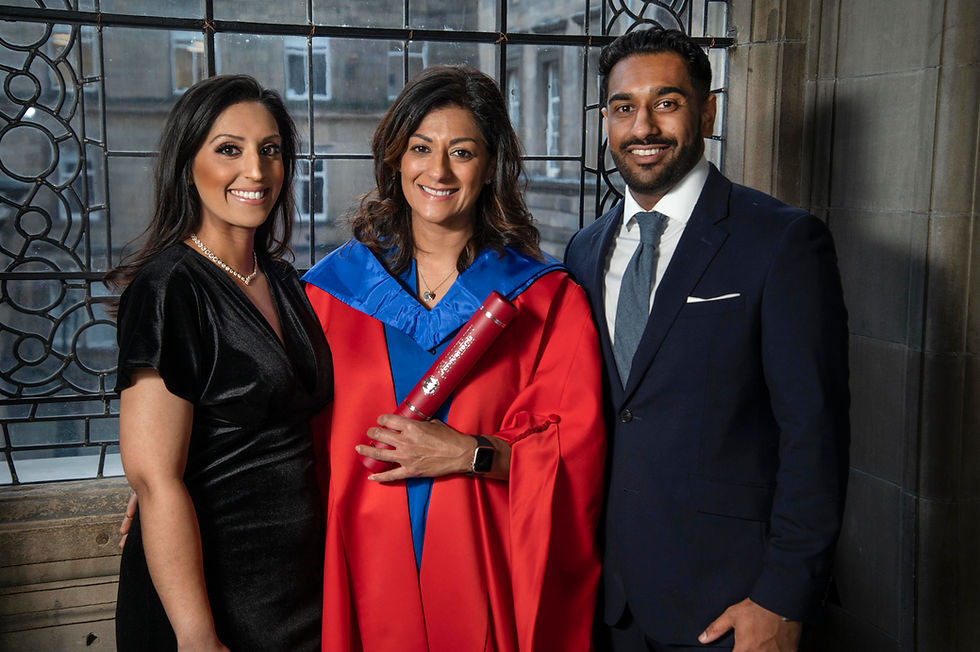
November 2024: Accompanied by my son and daughter, I received my honorary degree from the University of Edinburgh, a moment that celebrated not only personal achievement but also the strength of perseverance in the face of inequality.
Where Do We Stand in 2026?
This year’s UN Women theme, “Rights. Justice. Action. For ALL Women and Girls,” carries particular urgency. That urgency is underscored by renewed public attention to the abuse and trafficking of girls and young women revealed through investigations into Jeffrey Epstein’s crimes.
While there are other themes this year, against this backdrop, the call for rights, justice, and action for all women and girls is particularly compelling. It reflects the ongoing necessity of strengthening safeguards against exploitation, ensuring equitable access to justice, and prioritising survivor-informed reforms so that abuse cannot be concealed by influence or privilege.
Despite decades of progress, the data tells a measured story.
In 2026, women hold only 64% of the legal rights that men hold globally.
The World Economic Forum estimates that full global gender parity remains approximately 123 years away, placing potential parity around 2148.
The World Economic Forum’s Global Gender Gap Report 2025 further highlights that no economy has yet achieved full gender parity. Both developed and developing nations have significant work still to do.
Iceland continues to lead the Global Gender Gap Index, ranking first for the 16th consecutive year with a gender parity score of 92.6%. It remains the only economy to have closed more than 90% of its gender gap since 2022.
The United Kingdom now ranks 4th globally—an impressive rise from 14th place—with a gender gap closure score of 83.8%, trailing only Iceland, Finland, and Norway.
Looking more locally, while the WEF report measures at national level, Scotland stands out within the UK. According to PwC’s 2025 Women in Work Index, Scotland ranks first among UK regions, supported by strong female labour force participation (75%) and a narrowing gender pay gap.
These achievements are worthy of recognition. But progress, however encouraging, does not equal completion.
Why This Matters to the Corporate and Professional Community
International Women’s Day is sometimes criticised as a symbolic gesture. Yet in corporate and professional environments, it can serve as a strategic call to action.
Data-driven organisations understand that gender equity is linked to:
Stronger leadership pipelines
Broader perspectives in decision-making
Greater innovation capacity
Improved talent attraction and retention
Sustainable long-term performance
However, representation alone is not enough. Attention must also be given to introduction, retention, and advancement. Entry points matter. Career progression matters. Culture matters. Workplace structures matter.
Parity is not achieved by aspiration; it is achieved through intentional design and implementation.
The Purpose of International Women’s Day
If one day can raise awareness, deepen understanding, and encourage each of us to reflect on the improvements, however incremental, then perhaps it serves its purpose.
International Women’s Day provides space to pause and ask:
Are our systems equitable?
Are we retaining diverse female talent effectively?
Are we actively sponsoring future female leaders?
Are we measuring progress with the same rigour as financial performance?
The learning should never stop. Education sharpens awareness; awareness, in turn, informs action.
A Spotlight on the Scottish Legal Profession
To mark IWD within the Scottish legal profession this year, we have chosen to focus deliberately on the introduction, retention, and advancement of female talent, embracing diversity in its broadest sense.
Over the coming weeks, we will publish a series of four articles examining:
The data and trends across the profession
Entry into the profession and pathways to qualification
Retention and progression
Predictions and structural challenges shaping the future
Alongside this analysis, we will share personal reflections from female contributors from diverse backgrounds and career stages. This combined approach, with data and lived experience, aims to provide a comprehensive view of both the challenges and the opportunities facing the profession in 2026 and beyond.
We hope the series not only informs but invites participation. Progress accelerates when insight is shared.
So, Why Have International Women’s Day?
Because no country has yet achieved full parity.
Because progress remains uneven.
Because 123 years is too long to wait.
Because visibility drives accountability.
Because future generations should not have to navigate alone.
International Women’s Day is not simply about celebration. It is about collective responsibility.
The question we must ask ourselves, men and women alike, particularly those in leadership, is not whether progress is happening. It is whether we are prepared to accelerate and sustain it.
Our first International Women's Day article will be published on Monday 23rd February - make sure you are signed up to our email list to get the article straight to your inbox!


Comments